onsdag 4 mars 2015

Vad Saudierna säger om BiBis tal.

Faaisal
Skrven av chefsredaktören för Saudiarabiska engelska dagstidningen al-Arabiyah.

President Obama, listen to Netanyahu on Iran

Se vad Israel säger om artikeln.
 .
It is extremely rare for any reasonable person to ever agree with anything Israeli Prime Minister Benjamin Netanyahu says or does.

However, one must admit, Bibi did get it right, at least when it came to dealing with Iran.

The Israeli PM managed to hit the nail right on the head when he said that Middle Eastern countries are collapsing and that “terror organizations, mostly backed by Iran, are filling in the vacuum” during a recent ceremony held in Tel Aviv to thank outgoing IDF Chief of Staff Lt. Gen. Benny Gantz for his role during “challenging” times.

In just a few words, Mr. Netanyahu managed to accurately summarize a clear and present danger, not just to Israel (which obviously is his concern), but to other U.S. allies in the region.

What is absurd, however, is that despite this being perhaps the only thing that brings together Arabs and Israelis (as it threatens them all), the only stakeholder that seems not to realize the danger of the situation is President Obama, who is now infamous for being the latest pen-pal of the Supreme Leader of the World’s biggest terrorist regime: Ayottallah Ali Khamenei. (Although, the latter never seems to write back!)
Threat bigger than nuclear ambitions

Just to be clear, nobody disagrees that ridding Iran of its nuclear ambitions is paramount. And if this can be achieved peacefully, then it would be even better. However, any reasonable man CAN’T possibly turn a blind eye to the other realities on the ground.

Indeed, it is Mr. Obama’s controversial take on managing global conflicts that raises serious questions. A case in point is his handling of the Syrian crisis, where according to his own philosophical views, Obama probably takes pride that he managed to rid the Assad regime of its chemical weapons arsenal without firing a single bullet.

In just a few words, Mr. Netanyahu managed to accurately summarize a clear and present danger, not just to Israel (which obviously is his concern), but to other U.S. allies in the regionFaisal J. Abbas

Of course, in theory, this could be quite an achievement (which only another war philosopher, such as Sun Tzu, would applaud); but in reality, the problem with what happened is that the REAL issue hasn’t been resolved; as such, the Syrian regime continues – until this day – to slaughter their own people (albeit, using conventional weapons, you know… your everyday bullets, missiles and barrel bombs!)

As such, the real Iranian threat is not JUST the regime’s nuclear ambitions, but its expansionist approach and state-sponsored terrorism activities which are still ongoing.

What is noteworthy, is that whilst in the past Tehran plotted and implemented most of its terror activities in secret (apart from a few obvious examples such as the 1983 Beirut attack on U.S. Marines); the Islamic Republic seems so at ease today that, as noted by renowned media columnist Diana Moukalled recently, it went public with documenting the appearances of Iranian General Qassim Soleimani, commander of the Quds Force.

In her latest column, Moukalled wrote the days of the few, amateur shots of the infamous Commander are long gone.

“Since a few months, photos of Qassim Soleimani have become plentiful and available in High Definition.”

“Soleimani is no longer that secretive personality whose role over the past two decades has lingered been between myth and reality. He is now telling us bluntly: Yes, I am Iran’s strongman who is responsible for the Iranian military's expansion in Iraq, Syria, Lebanon, Yemen and Palestinian,” she wrote.


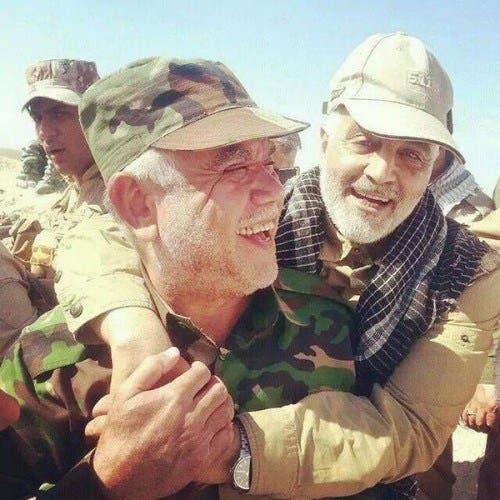
A photograph posted by Mashregh News, an Iranian outlet close to the country's Revolutionary Guards Corps, that shows top Iranian general Qassem Soleimani (R) embracing the leader of Iraq’s Shiite Badr militia Hadi al-Amiri. This picture is not dated, but is thought to have been taken in 2014.

Among his many handlings, Soleimani is the godfather of Iraq’s infamous “Asaa’ib Ahl Al-Haq” (AAS) brigade, a Shiite paramilitary terrorist group responsible for dozens of atrocious attacks and murdering of both Iraqis and Americans.
Iran supports al-Qaeda

Not only is Iran responsible for sponsoring Shiite terrorist groups, but Sunni ones too.

In fact, according to the U.S.’s own State Department, Tehran was home to a number of Al-Qaeda facilitators and high ranking financiers. These accusations are also backed by findings of the U.S. Treasury Department as well.

Not only is Iran responsible for sponsoring Shiite terrorist groups, but Sunni ones tooFaisal J. Abbas

Now, some would argue that it would be biased and/or naive to leave out Arab countries, such as Saudi Arabia, out of the equation and blame most of the regions problems on the mischievous Iranian regime.

On the contrary, it would be biased and/or naïve NOT to blame Iran for such problems. After all, yes there are terrorists in Saudi Arabia and there are people who financed terrorism, but these are officially outlaws, who are either in jail, being hunted down or are hiding in the caves of Tora Bora or some other remote area.

The same, sadly, doesn’t apply to the terrorists of Iran; these are in uniform, hold government positions and are not bothering to hide their evil plots anymore!
____________
Faisal J. Abbas is the Editor-in-Chief of Al Arabiya English, he is a renowned blogger and an award-winning journalist. Faisal covered the Middle East extensively working for Future Television of Lebanon and both Al-Hayat and Asharq Al-Awsat pan-Arab dailies. He blogs for The Huffington Post since 2008, and is a recipient of many media awards and a member of the British Society of Authors, National Union of Journalists, the John Adams Society as well as an associate member of the Cambridge Union Society. He can be reached on @FaisalJAbbas on Twitter.
Faaisal

Skrven av chefsredaktören för Saudiarabiska engelska dagstidningen al-Arabiyah.


tisdag 3 mars 2015

Netanyahus tal. - relevant lsäande.

Relevant läsande:

Boltons twitter (som hade varit min favoritpresident - vet alltid vad han talar om). https://twitter.com/ambjohnbolton

Twitter om talet: https://twitter.com/hashtag/Netanayahuspeech?src=hash

Talet: https://www.youtube.com/watch?v=XFcZVSvRQXo

Jag råkade se AB, vilket sker sällan men de var överst i Googlesök, på ämnet Netanyahu på svenska. Jo, läsningen var bra om man hade absolut behov av att spy, denna rappakalja av lögn, judehat och antisemitism, och total förvridning av någon som helst sanning. För att inte tala om alla väsentligheter de censurerat bort.

Khamenei har själv sagt att de inte tänker gå med på Obamas vanvettiga ideer, som jag skrev om just,  Nån mer än jag som märkt att madame Ashtons och Obamas "förhandlingar" under flera år enbart har gått ut på att acceptera mer och mer från Khamenei? Det har väl avancerat från 0 till 10000 centrifuger - Säkerhetsrådet tillåter 0.

AB upprepar skrönan att inte Obama fick veta om Netanyahus besök i tid, vilket är ren och skär lögn enligt NYT etc.

Inbjudan från talman i Kongressen skedde som förra gången.

Nära Israels val? Obama satsade ett antal miljoner på att sända en grupp lefties till Israel för att förstöra Netanyahus chanser vid valet. Konstigt att det försöker man tiga ihjäl. Mycket mer emot några protokoll än vad Netanyahu ägnat sig åt.

AB har ingen aning att 70% av USA står på Israels sida och att bara Obama är en monstruös israelhatare. Det positiva han gjort för Israel har han tvingats till. Så många ville se och höra Netanyahus tal att det var svårt att få tag på platsbiljetter

AB kort och gott hatar alla judar som försvarar sig själva.


.


Obamas sorgsna selfie-stick. Rolig video.

Gå till Pamelas artikel från Bolton , med video.


Obama’s Sad, Sick Selfie Stick - söker du på titeln hittar du många versioner och stories om vad Obama gör i stället för storpolitik. Det är vad han gör när han inte vågar träffa Netanyahu och diskutera fakta. Hoppas hans apkonster inte har med amerikansk politik att göra, bara hans egen personliga.


Söker du efter meningen på You Tube hittar du flera mer eller mindre relevanta, mer eller mindre roliga videos. Men nu börjar Netanyahus tal diskuteras världen över utom i DN, i alla fall vad jag kan se nu, 22:05.


Nu kommer ISIS, till Malta, Italien, Spanien.

Länk,

Försvarsmakten på Malta var i högsta beredskap både torsdag och fredag ​​som svar på ett möjligt terrorhot mot Malta, har The Malta Independent lärt.

Rapporter i dag i italienska medier tyder också på att Malta, tillsammans med Italien och Spanien, kan bli föremål för missiler som avskjutits från nordafrikanska länder av ISIS.

Förra fredagen förnekade inrikesminister Carmelo Abela att det fanns en sådan situation, säger det inte fanns någon anledning till oro.

Men färsk information som erhållits genom denna tidning går i strid mot  denna förnekelse.

På torsdag och fredag var armépersonal som var på permission inkallad från sin semester, medan andra stoppades från att ta ledighet.

Till detta fick armépersonal en onormal mängd ammunition, mycket mer än de får i normalfallet. Detta händer endast när varningsnivån höjts till högre nivåer, sade källorna The Malta Independent.

Soldater fick fler magasin med ammunition än de normalt har, och deras order var att vara mer på jakt efter något misstänkt beteende.

När han förnekade larmet var kanske inte ministern fullt informerad om situationen eller någon ville avdramatisera frågan för att inte orsaka panik, sade källorna.

Den högsta beredskapen i slutet av förra veckan kom bara två dagar efter det maltesisk-ägda Corinthia Hotel i Tripoli angreps.

Premiärminister Joseph Muscat hade sagt att Malta inte hade varit målet för terroristerna, men under dagarna som följde, informationen som mottagits höjde armén sin beredskap.

Italienska medier rapporterar att ISIS avsikt att avlossa missiler från nordafrikanska stater i Europa, med huvudmålen Italien, Spanien och Malta eftersom de är närmast Afrika. En karta har också reproducerats som visar hur attackerna är avsedda att äga rum.

Rapporterna säger att en kopia av propagandan publicerats avISIS "på bruten engelska" som anger att om ISIS besegras, skulle en plan utvecklas för missiler som ska sändas över havet från Nordafrika till Europa.

I rapporten sägs att även om utbudet av missiler nu inte är tillräckligt för dem att nå den europeiska kontinenten, kunde öarna vid södra Italien och under Italiens jurisdiktion som Pantelleria nås. Det tillägger dock att det kan skaffa andra missiler med längre räckvidd.

De italienska medier rapporterade att även om sådana hot har gjorts i propagandasyfte, bör de inte tas på allvar.


AFM on high alert last Thursday, Friday; Italian media report possible missile strikes

Tuesday, 3 February 2015, 13:25Last update: about 27 days ago


The Armed Forces on Malta was on high alert both Thursday and Friday in response to a possible terror threat against Malta, The Malta Independent has learnt.


Reports in the Italian media today indicate also that Malta, together with Italy and Spain, could be the target of missiles launched from north African countries by the Islamic State.


Last Friday, Home Affairs Minister Carmelo Abela denied that there was such a situation, saying there was no cause for alarm.


But fresh information obtained by this newspaper goes contrary to this denial.

On Thursday and Friday, army personnel who were on leave were recalled from their vacation, while others were stopped from taking leave.

Added to this, army personnel were given an abnormal amount of ammunition, much more than they are given in normal circumstances. This only happens when the alert state is upped to higher levels, sources told The Malta Independent.

Soldiers were given more magazines of ammunition than they normally have, and their orders were to be more on the lookout for any suspicious behaviour.

When he denied the alarm, the minister may not have been fully informed of the situation or else wanted to play down the issue so as not to cause any panic, the sources said.


The high alert at the end of last week came just two days after the Maltese-owned Corinthia Hotel in Tripoli was attacked.

Prime Minister Joseph Muscat had said that Malta had not been the target of the terrorists, but in the days that followed, information received led the army to raise its alert.

Italian media are reporting that ISIS intend to launch missiles from north African states into Europe, with the main targets being Italy, Spain and Malta as they are the closest to Africa. A map has also been reproduced showing how the attacks are intended to take place.

The reports say that a copy of propaganda published by the Islamic State “in broken English” indicates that should the Islamic State be defeated, a plan would unfold for missiles to be launched over the sea from north Africa to Europe.

The report says that although the range of the missiles presently in hand is not enough for them to reach continental Europe, islands to the south of Italy and under Italy’s jurisdiction like Pantelleria could be reached. It adds however that there could be other missiles with a longer range that could be obtained.

The Italian media reported that although such threats have been made for propaganda purposes, they should not be taken lightly.


DN: Obama säger att oddsen är emot ett avtal, men öser svavel över att Netanyahu månar om Israels existens. Ointresserade vad Khamenei säger.

Se DN, DN.  Se sen vad Khamenei säger nedan. Första DN-artikeln är spridd i dussintals svenska fantasilösa tidningar som inte har lust att jobba mer än att kopiera TT. Vilket är förbjudet enligt Pressens Etiska regler utan egen kontroll av fakta.

DN försökte en gång slippa TT:s förlamande blockering av att tidningar själva försöker hitta och verifiera nyheter, vilket hade varit mycket billigare i Internetvärlden, bara scanna några internationella nyhetsmedias utbud, men de var rädda att missa svensk Politisk Korrekthet och återkom till fållan. Sverige är ett EN-nyhetersland.

Rysslands nyheter på svenska är betydligt ner tillförliltliga än TT, se länk.

Obama talar om sin röda linje igen, inte för att det har räddat 200.000 mördade syrier. Dags för Ryssland igen att samarbeta mer med Israel?

Iran försöker utveckla en ny plutoniumgenererande reaktor, så som Pakistan fått sitt kärnmaterial, och nu försöker de köpa från Japan med alla pengarna Obama vill ge dom emot Kongressen. Samtidigt som oljerika Iran inte raffinerar nog med bensin för sina bilförare.

Iran säger att de avvisar Obamas krav på 10-års stopp på kärnkraftsarbete 


Reuters \ (men visst okänt i Sverige)
2015/03/03 13:03

Iranska FM: Teheran kommer inte att acceptera "överdrivna" och "oacceptabla" krav; säger Iran som kommer att fortsätta nukleära samtal med P5 + 1.

Obama och Khamenei. (Bild nedan)

Ankara - Iran avvisar som "oacceptabelt" ett ktsv från USA:s president Barack Obama att Teheran fryser sin känsliga nukleära verksamhet under minst 10 år, rapporterade den halvofficiella nyhetsbyrån Fars.

"Obamas hållning ... uttrycks i oacceptabla och hotande fraser ... Iran kommer inte att acceptera orimliga och ologiska krav ... Teheran fortsätter sina nukleära förhandlingar med de sex staterna," har utrikesminister Mohammad Javad Zarif sagt till Fars.

I en intervju med Reuters på måndagen, sade Obama att Iran måste engagera sig i ett kontrollerbart stopp på minst 10 år på känsliga nukleära arbeten för astt ett landmärke sksll nås mellan Teheran och de sex stormakterna.

USA och dess europeiska allierade fruktar att Iran vill utveckla förmåga att tillverka  atombomber. Teheran påstår att dess program är för enbart fredlig kärnkraftsenergi.

Iran och USA, Storbritannien, Frankrike, Kina, Ryssland och Tyskland har satt en tidsfrist på slutet av mars för ett ramavtal och juni för en omfattande slutreglering som skulle bromsa Irans nukleära verksamhet för att säkerställa att det inte kan gå till bombmaking i utbyte mot hävande av internationella sanktioner som har skadat Irans ekonomi. [IAEA har bekräftat att de inte har en aning om vad Iran sysslar med på många kärnforskningsställen, som jag skrivit tidigare.]

Iran vill snabbt häva sanktionerna som försöker stävja landets kärnenergiprogram - ett av stötestenarna i högnivåförhandlingarna som fortsätter i Schweiz denna vecka.

Obamas kommentar om tidsramen för en frysning utgör en av den amerikanska regeringens starkaste signalerna ännu sin röda linjen för en lyckad överenskommelse.


Iran says it rejects Obama's demand for 10-year nuclear work halt


By REUTERS \    (men visst okänt i Sverige)
03/03/2015 13:03


Iranian FM: Tehran will not accept "excessive" and "unacceptable" demands; says Iran will continue nuclear talks with P5+1.
Obama and Khamenei. (photo credit:REUTERS)

Ankara - Iran rejected as "unacceptable" a demand by US President Barack Obama that Tehran freeze its sensitive nuclear activities for at least 10 years, the semi-official Fars news agency reported.

"Obama's stance ... is expressed in unacceptable and threatening phrases ... Iran will not accept excessive and illogical demands ... Tehran will continue nuclear negotiations with the six powers," Foreign Minister Mohammad Javad Zarif was quoted as saying by Fars.

In an interview with Reuters on Monday, Obama said Iran must commit to a verifiable halt of at least 10 years on sensitive nuclear work for a landmark atomic deal to be reached between Tehran and six major powers.

The United States and its European allies fear Iran wants to develop atomic bomb capability. Tehran says its program is for peaceful nuclear energy only.

Iran and the United States, Britain, France, China, Russia and Germany have set a deadline of late March for a framework agreement and June for a comprehensive final settlement that would curb Iran's nuclear activity to ensure it cannot be put to bombmaking in return for the lifting of international sanctions that have harmed Iran's economy.

Iran wants a swift lifting of the sanctions in any deal curbing its nuclear program -- one of the sticking points in high-level negotiations continuing in Switzerland this week.

Obama's comment about the time frame for a freeze represents one of the US government's strongest signals yet of its red line for a successful agreement.


måndag 2 mars 2015

Kejsar Obama anser att han står över Säkerhetsrådet.

http://en.wikipedia.org/wiki/United_Nations_Security_Council_Resolution_1696
(Översatt till många språk men inte svenska.)

Säkerhetsrådet förbjuder Iran att fortsätta med kärnkraftsutveckling punkt och slut. Enligt Kapitel VII vilket innebär mer än en rekommendation utan en order som andra länder får åtgärda. Tydligen blir det Israels jobb.

FN:s uttalande på länk från år 2006, vilket Obama och de andra stora makterna än inte upptäckt.


När ISIS anfaller EU vem skyddar oss? EU, nä, FN, nä, Obama, nä, NATO nä italien gör vad de kan, EGYPTEN attadkerar ISIS.

ISIS håller på att vältra in i EU, FN gör inget, Obama gör inget nu när det är livsviktigt, jämför när Obongon fick för sej att attackera Ghaddafi förra gången mot Kongressens vilja och ställa till röran nu. NATO och EU sitter i sammanträden det kommande året. Det heliga Schengen som är livsfarligt i nuvarande situation, får inte diskuteras. Flytta Italien ur Schengen så länge det övervältras av hitlockade flyktingar via Lampedusa. Nähä, terrorhot är väl ingen anledning, Så vem får göra jobbet utan tack?

Har Sverige gjort ett enda dyft mot ISS ? Mer än att försäkra pojkarna att de inte är folkmördare bara för att de mördar folk, som Wallström utstötte.

söndag 1 mars 2015

Singapore försöker öka Israels investeringar där.

http://www.jpost.com/Business/Singapore-seeks-to-ramp-up-Israel-investment-392599

EU:s påtagliga naziinflytande - minns Hitlers "Kauft nicht bei Juden". Identiskt med EU:s, så allt fler civiliserade stater närmar sig nu Israel mer och mer. Singapore och Israel har länge samarbetat. Min allra första emailkontakt i Asien var en kinestjej som jobbade på utbildningsmisteriet där, speciellt samarbetade länderna då angående utbildning av speciellt begåvade barn - sånt man inte får göra i Sverige, här pressas de bara ner för att bli "som alla andra". He äe ju alla lika enligt dekret från regeringen. Vi träffades i Singapore - sen gifte hon sej med en kompis till mej här i stan.

Och som du ser på två långa artiklar jag lagt ut håller Kina på att vidga den nya Silkevägen från Kina via Sydostasien till Mellanöstern och EU.

Glamoröst, EU isolerar sig från utvecklingslandet Israel medan Asiens utvecklingsländer ökar förbindelserna. Vem tror du förlorar? Både Indien och Kina är dubbelt så stora som EU och utvecklas konstant.


Singapore försöker stega upp Israels investeringar

Båda är högteknologiska nationer med små populationer, vilket innebär att de måste vända sig till bredare marknader.

En gäst simmar i infinity pool vid Skypark som toppar Marina Bay Sands hotell i Singapore [bild nedan]
]
Singapore är ute efter att öka sina investeringar i Israel, och fungera som en bro till den bredare asiatiska marknaden.

"Vi märker att det finns en lucka där nere. Israeliska företag kommer inte till den asiatiska marknaden så mycket som de borde. Vi insåg att det här är en möjlighet för oss ", säger Alex Lim, global chef för Infocomm Investments (IIPL), en ny $ 200.000.000 fond upbackad av den singaporianska regeringen som vill investera i nystartade företag och tillväxtföretag runt om i världen.

Lim, som var en del av en företagsdelegation i Israel förra veckan, sade att Israels kompetens inom en rad olika områden såsom stora datamängder, smarta städer och it-säkerhet var attraktivt för stadsstaten, som delar flera gemensamma nämnare med Israel.

Båda är högteknologiska nationer med små populationer, vilket innebär att de måste vända sig till bredare marknader. För Israel, sade han, kan den amerikanska tyckas naturligt val, men Asien har mycket att erbjuda.

"Det är alltid lätt att åka till USA, men USA blir väldigt trångt, så de måste öppna upp och börja titta på andra platser", sade han. Sydostasiatiska nationernas förbund (Asean) av länder har en befolkning över dubbelt så stor som USA och en krävande klass som är nästan dubbelt så stor.

Trots skillnader i språk i kultur i de tio länderna säger Lim, är den krävande klassen ganska homogen bland dem.

Delegationen, som fortsatte tillsammans med sina israeliska motsvarigheter till Mobile World Congress i Barcelona, ​​var i Israel delvis för  att trumma upp stöd för en stor konferens i Singapore i slutet av april, InnovFest UnBound.

Daniel Seal, VD för AcreWhite, vilken hjälpte till att organisera delegationen, konstaterar att singaporianska investerare redan har investerat i några större israeliska nystartade företag, såsom PlayBuzz, Volera och Tracx.

"Nyheten här är att Singapore verkligen aggressivt är ute efter att stärka relationen i näringslivet-tech sektorn", sade han. "De ser sig själva som judar av Asien."

Singapores turiststyrelse, som aktivt söker affärsförbindelser som en del av sitt uppdrag, ligger bakom satsningen också.

"De kommer att börja aktivt investera mer. Under det kommande året,  kommer du att se mycket mer Singaporeaner runt ", säger Seal.


Singapore seeks to ramp up Israel investment


Both are high-tech nations with small populations, meaning they have to turn to broader markets.


A guest swims in the infinity pool of the Skypark that tops the Marina Bay Sands hotel towers in Singapore. (photo credit:REUTERS)


Singapore is looking to increase its investments in Israel, and serve as a bridge to the wider Asian market.

“We notice there’s a gap down there. Israeli companies don’t come to Asian that often. We realized that this is an opportunity for us,” said Alex Lim, Global Head of Infocomm Investments (IIPL), a new $200 million Singaporean Government backed fund to invest in start-ups & growth stage companies around the world.

Lim, who was part of a business delegation in Israel last week, said Israel’s expertise in a variety of fields such as big data, smart cities and cyber security were an attractive draw for the city-state, which shares several commonalities with Israel.

Both are high-tech nations with small populations, meaning they have to turn to broader markets. For Israel, he said, the US may seem a natural choice, but Asia has a lot to offer.

“It’s always easy to go the US, but the US is getting very crowded, so they have to open up and start looking at other places,” he said. The Association of Southeast Asian Nations (ASEAN) countries alone have a population over double that of the US, and a consuming class that’s nearly twice as large.

Despite differences of language in culture in the ten countries, Lim says, the consuming class is fairly homogeneous among them.

The delegation, which continued alongside its Israeli counterparts to the Mobile World Congress in Barcelona, was in Israel in part to drum up support for a large conference in Singapore at the end of April, InnovFest UnBound.

Daniel Seal, the CEO of AcreWhite, which helped organize the delegation, notes that Singaporean investors have already made investments in some major Israeli start-ups, such as PlayBuzz, Volera and Tracx.

“The news here is that Singapore is really aggressively looking to strengthen the relationship in the business-tech sector,” he said. “They see themselves as the Jews of Asia.”

Singapore’s tourism board, which actively seeks business ties as part of its mission, is behind the venture as well.

“They’re going to start actively investing more. Over the next year, you’re going to see a lot more Singaporeans around,” said Seal.


Kina: Ett fotfäste i Suez, men vy på Israel.

Jag skrev nyss om Kinas Silkesväg, här mera om deras tankar om både Suez och Israelvägen. TGS


China’s Silk Road Strategy: A Foothold in the Suez, But Looking To Israel

Publication: China Brief Volume: 14 Issue: 19
October 10, 2014 04:00 PM Age: 141 days

COSCO's Mercury, the biggest Chinese commercial shipping vessel.
China plans to develop a Silk Road economic belt that spans the Eurasian continent and a maritime Silk Road that links the Pacific with the Indian Ocean. We can see on a map that the two Silk Roads will cross in the Middle East region, which spells excellent opportunities and bright prospects for common development and common prosperity for China and the region’s countries.
 – Chinese Foreign Minister Wang Yi (Chinese Ministry of Foreign Affairs, January 14).
The Silk Road narrative espoused by Chinese Foreign Minister Wang Yi evokes China’s strategy of developing linking transportation nodes between maritime port terminals and inland rail networks throughout Eurasia, including across the Middle East and North Africa (MENA) region. With the overall purpose of carving out new export markets, this Silk Road strategy simultaneously seeks to develop large-scale transportation infrastructure construction projects for China’s state-owned enterprises (SOE) and create transportation routes to export products to foreign markets. Furthermore, as China’s national development has become increasingly dependent on maritime commerce to reach the global marketplace, Beijing has sought to minimize the risk of shipping disruptions by reducing its dependence on any single route through developing a variety of transportation corridors.
In order to ensure reliable access for Chinese commercial shipping from the Red Sea to the Mediterranean Sea, the Chinese government has adopted a dual-track approach, simultaneously expanding its interests in the Suez Canal corridor while also pursuing a land-based route through Israel. For its preferred maritime strategy, China’s state-owned shipping companies have invested in ports along the Suez Canal Corridor, from the Gulf of Suez to Port Said in Egypt. For China’s alternative land-based route, Beijing is pursing the “Red-Med” rail project, which completely avoids the Suez Canal by traversing Israel from Eilat on the Gulf of Aqaba to Tel Aviv on the Mediterranean. These two routes position China to realize its goal of the two Silk Roads meeting in the MENA region.
High Stakes in the Suez Canal
Beijing’s current reliance on the Suez Canal for shipping Chinese exports to Europe represents an increasing risk to the continued growth of China’s economy. Prior to the Arab Spring in 2011, China invested heavily in the Suez Canal corridor and considered the Canal its primary access point to Europe, China’s largest export market. In 2008, COSCO Pacific, China’s largest shipping SOE, invested $185.6 million in a joint venture to operate and manage the Suez Canal Container Terminal (SCCT) in Port Said East Port, located in the western Sinai peninsula at the northern end of the Canal (Cosco Pacific Announcement, December 11, 2008). For this port’s second development phase, operating since 2012, state-owned China Harbor Engineering Company (CHEC) invested $219 million to construct a 1,200-meter quay (CHEC Press Release, November 8, 2008). CHEC also completed a contract valued at $1 billion to construct a quay in al-Adabiya port at the southern entrance to the Canal (CHEC, 2009).
The overthrow of Egypt’s longtime strongman ruler Hosni Mubarak during the Arab Spring in 2011 turned the economic and security risks of China’s overdependence into a reality when Chinese cargo ships were severely delayed in the Suez Canal. Ain Sokhna, al-Adabiya and Port Said East Port experienced intermittent closures, causing a severe container backlog and preventing, on one occasion, Chinese ships from working for over ten days (Port Technology, February 11, 2011; Daily News Egypt, July 11, 2011; Daily News Egypt, December 20, 2012). A representative from China Shipping said that on other occasions their ships were diverted to the Israeli ports of Ashdod, 24 miles south of Tel Aviv, and Haifa, 55 miles north of Tel Aviv (Author’s Interview, Port Said, February 26, 2013).
Beyond shipping delays, the turmoil following the removal of Mohammed Morsi from power further increased security risks to ships using the Suez Canal. On August 31, 2013, China’s COSCO Asia, one of the company’s newer and larger vessels, came under fire from two rocket-propelled grenades 30 miles south of Port Said at al-Qantarah, after leaving Suez Port on the southern entrance to the Canal (Egypt Independent, September 1, 2013). The al-Furqan Brigades, who claimed responsibility, said they carried out the attack because the Suez Canal “has become a safe passageway for the Crusader aircraft carriers to strike the Muslims, and it is the artery of the commerce of the nations of disbelief and tyranny” (The Long War Journal, September 7, 2013). China’s policy of support for the long-standing military regimes in MENA and unfounded accusations that a PLA Navy (PLAN) escort fleet transited the Canal to supply arms to Bashar al-Assad illustrates a sense of enmity towards China (Al Arabiya News, July 30, 2012; QQ, July 27, 2012; Global Times, July 30, 2012). While little damage to the ship was reported, the event underlines the risk of shipping disruptions that the Chinese government seeks to minimize through its dual land and sea strategy.
Yet, China has redoubled its bet on the Suez even after the recent turmoil. According to a representative from China Shipping, a third development phase is underway, which would constitute an extension of Port Said West Port (Author’s Interview, Port Said, February 26, 2013). Furthermore, Zhenhua Port Machinery Company, a subsidiary of China’s state-owned Communication Construction Company (CCCC), secured a large-scale infrastructure project for U.A.E.’s Dubai Port World Sokhna under development alongside the China-Egypt special economic zone on the Gulf of Suez (Port Technology, July 12, 2012). China proceeded with a $416 million investment in a second contract, for construction of a cargo terminal at al-Adabiya port (Chinese Embassy in Egypt, July 17, 2012). China is also considering the Suez Canal Regional Development Project (SCRDP), which includes the addition of a parallel channel to the Canal, as well as the construction of sub-sea tunnels under the Canal (Daily News Egypt, September 16; Foreign Ministry, August 14).
Seeking an Alternative Route Through Israel
The “Red-Med” railway through Israel represents China’s efforts to address its overdependence on the Canal and create a viable backup plan to ensure reliable passage for Chinese commerce from the Red Sea to the Mediterranean Sea and on to Europe. The railway, a proposed twin-track, one for passengers and one for cargo, is expected to hurtle through Israel’s Negev desert at speeds of 155–185 miles per hour (Global Times, July 5, 2012). Of the total 217-mile distance, a passenger track of 55 miles from Tel Aviv to Beersheva has already been completed by an Israeli SOE, Netivei Israel; this line will then be connected to an existing track that runs from Beersheva to Dimona, and thereafter a further 150-mile track that has yet to be built will run to the port of Eilat on Israel’s Red Sea coast. This “Red-Med” railway will support China’s ambitions to carve out Israel as an export market, as it will allow shipping containers coming from China to be transported via the railway to Israel’s interior (Globes Online, July 13, 2011; Globes Online, July 20, 2012).
However, extensive engineering challenges and the railway’s high projected cost are potentially prohibitive issues for the project’s successful completion. In total, the railway would include 63 bridges extending two miles and five tunnels totaling five miles, raising questions about the project’s feasibility (Globes Online, February 29, 2012; Globes Online, October 6, 2013). Current cost estimates range from $8–13 billion, and since transportation of goods by rail is more expensive than by sea, the long-term profitability of the project is not assured (Globes Online, October 6, 2013; Globes Online, May 26, 2013).
Israeli Prime Minister Benjamin Netanyahu welcomes China’s railway plan, as long as China is willing to pay for it. China’s Transport Ministry has been in talks with its Israeli counterpart since Israel opened the project to public bidding in late 2010, and the two Ministries signed a memorandum of understanding (MOU) in July 2012, paving the way for the official negotiations (Globes Online, July 3, 2012). For Israel, China’s involvement in the project would bring Chinese funding, provided by the state-owned Import-Export Bank and a Dubai-based investment company, as well as a Chinese construction company to lead development (Al Monitor, October 22, 2013). For Beijing, this government-to-government agreement would provide China export credits, boost its construction SOEs and create employment opportunities for Chinese nationals abroad. Yet, some in the Israeli government oppose the deal, so it is still in the early earlstages.
One part of China’s Silk Road strategy in Israel that is for certain is a project to connect the railway to Israel’s Mediterranean ports of Haifa and Ashdod. In June, CHEC won the pre-qualification stage of two tenders, after submitting unbeatably low-priced bids, to build one new port in either Haifa or Ashdod, and ultimately decided to build South Ashdod port (Globes Online, June 23). While COSCO Container Lines already offers a transatlantic service from Haifa and a trans-shipment service from Ashdod to Europe’s Mediterranean ports, this new project illustrates China’s ambitions to fortify its Silk Road in Israel. At the signing ceremony, China’s Ambassador to Israel, Gao Yanping, said, “This project will effectively open up the Israeli market to China” (The Times of Israel, September 23).
However, China’s alternative strategy through Israel still poses similar risks to that of the Suez Canal in Egypt. In January, a Sinai-based jihadist group named Ansar Jerusalem claimed responsibility for a rocket attack on the city of Eilat, and on July 7, as the Israel-Palestinian conflict began, a German cruise ship was showered with shrapnel from a Hamas rocket after leaving Ashdod port (Xinhua, January 22; The Guardian, July 8). Nevertheless, China continues to pursue projects in Israel.
Toward a Modern Silk Road: China Pursues a “Dual Approach”
China’s interest in the ambitious “Red-Med” railway appears to have crystallized after the numerous threats to its interests in Suez since 2011. As Zhang Le, China program coordinator for the U.S.-based non-profit Israel Project, maintained, “The railway has strategic significance because it will also provide a land-based passage for Chinese cargo to Europe, in addition to the Suez Canal” (Global Times, July 5, 2012). China’s Minister of Transportation Li Shenglin said that the signing of the MOU would set “a new stage” for cooperation between the two countries’ transportation companies (Global Times, July 7, 2012). Reflecting his country’s view of China’s involvement, Netanyahu said, “We have the ability to create an alternative transportation route that bypasses the Suez Canal—this is an insurance policy. Israel must become a continental land crossing route and create great power interests” (Prime Minister’s Office Press Release, February 5, 2012).
Israel’s proposal for the “Red-Med” railway must also compete with a number of other similar projects seeking Chinese funding around the world. CHEC and the Chinese-Panamanian Office of Business Development have expressed interest in constructing a fourth set of locks in the Panama Canal beyond the current expansion expected to be completed in 2015 (Xinhua, August 6). Furthermore, a Chinese businessman won a 50-year concession for $40 billion to construct an inter-oceanic Nicaragua Canal (Xinhua, June 13). While further development of the Suez Canal and additions to the Panama Canal constitute upgrades to existing projects, the Nicaragua Canal is much more of a long-standing dream than a solid feasible engineering project (Christian Science Monitor, January 22).
China’s Future Still Depends on the Suez
Despite Beijing’s pursuit of alternative routes beyond the Suez Canal, China will likely remain dependent on it for the foreseeable future, due to its large capacity that is needed to accommodate the growing size of cargo ships. The biggest advantage of the Suez Canal over the Panama Canal is that the former is wider, allowing the passage of larger ships, which Chinese companies value for their economies of scale. The Suez Canal and the SCCT are already capable of handling the world’s largest container ship, the Malaccamax, an 18,000 twenty-foot equivalent unit (TEU) vessel, tipped as the future global norm. Upon completion of the expansion currently underway, the Panama Canal will only be able to accommodate 12,500-TEU ships. The size of China Shipping’s largest ship is currently 14,000 TEU, already too large for the Panama Canal (China Shipping Turkey, 2014). Thus, Chinese companies will likely remain dependent on the Suez Canal as they follow global trends toward larger ships in the future.


De Israeliska ledarna har vikit sig för allt liksom Chamberlain.

http://www.jpost.com/Opinion/Into-the-Fray-The-Chamberlainization-of-Israeli-politics-392370

Israel hade några starka envisa ledare för länge sedan i Jabotinskys stil, som Begin, Golda - men sedan, speciellt sen Rabin gjorde ett fruktansvärt alternativ som tusentals israeler dött för, eftersom han ett ögonblick trodde på vad Arafat sa, inte ett löfte från PA, Palestinian Authority, har hållits! Sean kom den amerikanska Vägplanen som specifikt krävde åtgärder från båda sidorna för att gå framåt, vilken slutade med en Palestinsk Stat. PA uppfyllde inte ens ingångssteget för att vägplanen skulle komma igång.....  Olmert ville förstås gå baklänges och FÖRST ge dom en stat, belöningen för att ha passerat alla stegen. Netanyahu vill fortfarande ge dom en stat att anfalla Israel från.


Into the Fray: The Chamberlainization of Israeli politics


 We regard the agreement signed last night night... as symbolic of the desire of our two peoples never to go to war with one another again… a British prime minister has returned from Germany bringing peace with honor. I believe it is peace for our time.

– Neville Chamberlain, 1938, in wake of signature of the Munich Agreement with Hitler

You were given the choice between war and dishonor. You chose dishonor and you will have war.

– Winston Churchill, 1938, in wake of signature of the Munich Agreement with Hitler

In war, whichever side may call itself the victor, there are no winners… all are losers…. We should seek by all means in our power to avoid war, by analyzing possible causes, by trying to remove them, by discussion in a spirit of collaboration and goodwill… even if it does mean the establishment of personal contact with the dictators.

– Neville Chamberlain, 1938

You ask, what is our policy? I will say: It is to wage war, by sea, land and air, with all our might and with all the strength… to wage war against a monstrous tyranny…. You ask, what is our aim? I can answer in one word: victory; victory at all costs, victory in spite of all terror, victory, however long and hard the road may be; for without victory, there is no survival.

– Winston Churchill, 1940

Since the late 1960s, following the sweeping military victory of the Six Day War, Israeli politics has been undergoing a malignant metamorphosis. Its progression was gradual, barely perceptible, until the early 1990s, when the metamorphosis mutated into a massive metastasis.


From vaunted virtue to vilified vice
The result has been a stunning sea-change, which has transformed the conduct of the political discourse, the substance of accepted/ acceptable political perceptions, and the assessment of existing/desired political outcomes, making them all virtually unrecognizable relative to those that prevailed decades ago.

The 1993 Oslo Accords, in which Israel agreed to accept the terrorist PLO as a legitimate negotiating partner, was a dramatic discontinuity in the evolution of Zionism.

Indeed, it soon saw a profound transformation of political processes in Israel, in which everything that came after it was qualitatively different – often diametrically opposed – to what came before.

As I noted in my column “Religion of retreat” (June 26, 2014): “Not only did the [Oslo process] grossly distort the founding ethos of Zionism, it inverted its essence and [reversed] the thrust of Zionism’s fundamental principles. What was once vaunted as virtue became vilified as vice – and vice versa.

Thus, it ushered in the previously taboo of Palestinian statehood as an acceptable, even preferred, mainstream policy option.

To justify this ideo-intellectual somersault, its architects began spawning an approach – or rather, a syndrome – that elevated surrender of homeland and abandonment of kin as the loftiest of enlightened values, while denigrating any sign of assertive endorsement of Jewish identity or solidarity as “ethnocratic racism.”

From defiant ‘David’ to compliant ‘Goliath’
Now, almost a quarter-century after the fatal concoction of the noxious Oslowian brew that culminated in the so-called Declaration of Principles (aka Oslo I) on the White House lawn in September 1993, Israel is a vastly different place – not only in terms of outer physical appearance, but in terms of inner spiritual vigor. There appears to be an inverse relationship between the height and opulence of the myriad towering high-rises, springing up in cities all around the country, and the level of national pride and self-esteem Israel conducts itself with in the international arena.

Paradoxically, as the external signs of material success multiply, there seems to be a diminishing belief in the nation’s ability to determine its destiny. The greater the economic prosperity and technological advancement, the less its apparent will to exercise its rights as a sovereign state.

Increasingly, Israel seems to see itself (and allows others to see it) less and less as a diminutive but daringly defiant “David,” and more and more as a compliant “Goliath,” susceptible to pressure, acquiescing to ever-more outrageous demands, plainly detrimental to its national interest, in a frantic effort to avoid appearing intransigent.

But of course, complying with such demands is inevitably counterproductive, for it only whets appetites for further and more far-reaching demands – and heightens impatient expectations that they be complied with, forthwith.

Slippery slope…
In the first volume of his epic series on the Second World War, Winston Churchill, traced the tragic chain of events the Chamberlain government’s policy of appeasement had wrought just prior to the German invasion of Poland: “Look back and see what we had successively accepted or thrown away: a Germany disarmed by solemn treaty; a Germany rearmed in violation of a solemn treaty; air superiority or even air parity cast away; the Rhineland forcibly occupied and the Siegfried Line built or building; the Berlin- Rome Axis established; Austria devoured and digested by the Reich; Czechoslovakia deserted and ruined by the Munich Pact, its fortress line in German hands, its mighty arsenal of Skoda henceforward making munitions for the German armies... the services of 35 Czech divisions against the still unripened German Army cast away... all gone with the wind.”

He lamented the folly and the inevitable consequences of this policy: “... if you will not fight when you can easily win without bloodshed; if you will not fight when your victory will be sure and not too costly; you may come to the moment when you will have to fight with all the odds against you and only a precarious chance of survival…” Sternly, he warned of the “wrong judgments formed by well-meaning and capable people,” who, “however honorable their motives,” would be “blameworthy before history” for facilitating the tragedy he correctly foresaw, resulting from their futile attempts to assuage dictators by accommodating their demands.

Pernicious parallel
Israeli political leaders would do well to heed the lesson to be learned from the catastrophic consequences that continued concession and capitulation culminated in, for a similar process has afflicted Israeli policy in its struggle to contend with its tyrannical Arab adversaries.

This pernicious parallel is thrown into stark relief by Yitzhak Rabin’s final address to the Knesset (October 5, 1995), barely a month before his assassination. In the address, in which he sought parliamentary ratification of the Oslo II Agreement, he laid out his vision for the permanent agreement with the Palestinians.

Repudiating the now well-known Obama prescription, he asserted categorically, “We will not return to the June 4, 1967, lines.”

Rejecting the idea of a sovereign Palestinian state, he declared: “The permanent solution will include a Palestinian entity which will be an entity which is less than a state.”

Rabin then went on to detail some of “the main changes... which we envision and want in the permanent solution.”

On Jerusalem: “First and foremost, a united Jerusalem, including both Ma’aleh Adumim and Givat Ze’ev – as the capital of Israel, under Israeli sovereignty.”

On the Jordan Valley: “The security border of the State of Israel will be located in the Jordan Valley, in the broadest sense of that term.”

On settlements: “Changes which will include the addition of Gush Etzion, Efrat, Betar and other communities, most of which are in the area east of what was the Green Line prior to the Six Day War.”

And perhaps most significantly: “The establishment of [new] blocs of settlements in Judea and Samaria, like the ones in Gush Katif” – the latter subsequently destroyed by Ariel Sharon’s 2005 Gaza disengagement.

Once unthinkable concessions; today policy imperatives

As I have pointed out in previous columns (see for example, “A hijacked ‘heritage,’” October 17, 2013) in which I referred to this address, it is remarkable for a number reasons.

First, as mentioned, it was made just prior to his assassination, and as such was his last public prescription for a permanent resolution of the conflict with the Palestinians.

Moreover, not only was it delivered after he had been awarded the Nobel Peace prize and hailed internationally as a “valiant warrior for peace,” it conveyed to the Israeli public the outcome they should expect at the culmination of the Oslo process. Finally, it should be recalled that, at the time, this Oslo-compliant position articulated by Rabin was considered a radical lurch leftward, entailing concessions not only unthinkable prior to his 1992 election, but totally incompatible with the platform he had presented to the voter.

Yet despite all this; despite fact that the Oslo formula as presented by Rabin was considered by much of the electorate as excessively – indeed, unacceptably – concessionary; despite the fact that it was only ratified in the Knesset by the vote of a soon-to-be convicted drug-smuggling fraudster (then- MK Gonen Segev), if, in the present political climate, it was embraced verbatim by Benjamin Netanyahu and his government, they would be dismissed as unreasonable, unrealistic rejectionists.

Thus, by an ongoing process of attrition by the Arabs on the one hand, and capitulation by the Jews on the other, what once were unthinkable concessions became perceived policy imperatives for any conceivable configuration of a resolution of the conflict with the Palestinians.

Uselessness of unctuousness
Predictably, the Oslo-complicit concessions did little to advance the cause of peace or assuage Palestinian grievances. Far-reaching offers, acquiescing to virtually all Palestinians demands, by Ehud Barak and Ehud Olmert were rejected or ignored, only precipitating more violent conflagrations.

Further conciliatory gestures by Netanyahu – his acceptance of Palestinian statehood, the construction freeze in Judea-Samaria, the unrequited release of convicted terrorists – were to no avail – either in advancing substantive accords with the Palestinians or in obviating his image as a rejectionist with the international community.

Last week, The Jerusalem Post’s Sarah Honig, with her usual eloquence and perceptiveness, provided a scathing indictment of the self-obstructive – even self-destructive – obsequiousness that has taken hold of many in the Israeli political establishment, willing to imperil themselves, their people and their country, in a desperate endeavor to avoid angering others.

Focusing on the domestic censure of Netanyahu’s acceptance of the offer to address a joint session of Congress to convey his grave misgivings as to the dangers entailed in the emerging agreement on the Iranian nuclear program, she commented bitterly: “You can take the Jew out of the Diaspora, but not all the Diaspora out of all Jews. Israel’s Left and its media mouthpieces are prime examples.

To hear them, Prime Minister Benjamin Netanyahu has unpardonably angered the nobleman from the Oval Office. It was Netanyahu’s duty to obediently... self-destruct to appease his boss.”

It seems Chamberlain is alive and well in influential political circles in Israel.

Selling surrender as strategy
Astonishingly, undeterred by Arab intransigence, the Israeli adherents of the Chamberlainesque policy of political appeasement and territorial withdrawal have now come up with an even more radical proposal in their obsessive and futile pursuit of an unattainable peace accord.

Although many on the Israeli Left have despaired of reaching such an accord through bilateral contacts with the Palestinians, they have now embraced a new and more perilous paradigm – originally named the Saudi Peace Plan, now known as the Arab Peace Initiative.

The initiative is, in effect, a document of surrender to the Arabs, which in erases all the accomplishments of the 1967 Six Day War and even some of the 1948 War of Independence.

It contravenes every single element of Rabin’s previously cited prescription. It demands: (a) Israel return to the 1967 lines – with or without insignificant land swaps (b) the division of Jerusalem, (c) the evacuation of the Golan, and (d) a “just settlement” of the Palestinian refugee “problem.”

In short, it is a transparent blueprint for the staged annihilation of the Jewish state, which makes the fact that almost 200 senior security experts have embraced it – together with the ridiculous notion of a “regional solution” – as a “strategic initiative,” all the more distressing. But more on the Arab Peace Initiative and the “regional solution” in coming weeks.

Historians will be baffled
Allow me to conclude with one more excerpt from Churchill. He warned that “if mortal catastrophe should overtake the British Nation and the British Empire, historians a thousand years hence will still be baffled by the mystery of our affairs. They will never understand how it was that a victorious nation, with everything in hand, suffered themselves to be brought low, and to cast away all that they had gained by measureless sacrifice and absolute victory.”

The same goes for Israel.

Martin Sherman (www.martinsherman.org) is the founder and executive director of the Israel Institute for Strategic Studies. (www.strategicisrael.org)