Visar inlägg med etikett Hizbollah. Visa alla inlägg

söndag 12 november 2017

Hariri i Saudiariarabien. Versioner.. Viktig uppdatering.

Uppdatering:

Al-Hariri: Hezbollah must not be allowed to destroy Lebanon


Saad Al-Hariri, who resigned last weekend as prime minister of Lebanon, said on Sunday that Hezbollah must not be allowed to destroy Lebanon.
Responding to claims from opponents in Lebanon who claimed his resignation speech was dictated by Saudi Arabia, he told interviewers from the television station of his Future movement that he wrote it himself and that he would return to Lebanon in the next few days.

AB svarar:
 https://www.aftonbladet.se/senastenytt/ttnyheter/utrikes/article26566704.ab
Arabförbundet ...


Libanons premiärminister: Jag kommer hem snart

LIBANON/SAUDIARABIEN. Libanons premiärminister Saad al-Hariri kommer "inom kort" att återvända till hemlandet från…


Tidigare

Aftonbladet redan försvunnen:  De tre stilarna varierar. Först AB:


Libanons president kräver svar av Saudiarabien

UTRIKES
LIBANON. Libanons president Michel Aoun vill ha en förklaring från Saudiarabien till att den avhoppade premiärministern Saad al-Hariri inte återvänt till landet.
Kravet kommer efter uppgifter om att al-Hariri hålls i husarrest i Saudiarabien.
Aoun uppmanar Saudiarabien att "klargöra vad som hindrat att premiärminister al-Hariri återvänder till sitt folk och sina anhängare i Libanon". En uppsatt libanesisk källa säger också att Aoun förklarat för utländska ambassadörer att al-Hariri har "kidnappats".
al-Hariri, som under mystiska omständigheter meddelade sin avgång under ett besök i Saudiarabien, måste återvända till Libanon för att få sin avgång formellt godkänd av Aoun. Presidenten anser också att man inte kan lita på uttalanden som al-Hariri gör från Saudiarabien, eftersom de "reflekterar de omständigheter han befinner sig i" och att de faktiska omständigheterna är "oacceptabla".

Fälla slog igen

En vecka efter det att al-Hariri, som även är saudisk medborgare, lämnat Libanon går rykten om att han hålls i husarrest i Riyad. Detta förnekas dock av Saudiarabien.
Men högt uppsatta källor i Libanon uppger för nyhetsbyrån AP att en fälla slog igen bakom al-Hariri när han landade i Saudiarabien fredagen den 3 november. Inga officiella företrädare väntade på flygplatsen för att ta emot honom, vilket är naturligt när en premiärminister kommer på officiellt besök. Dessutom togs al-Hariris mobiltelefon ifrån honom och nästa dag tvingades han läsa upp meddelandet om sin avgång i tv, uppger källorna.


Saudis call emergency Arab League session on Hariri’s testimony against Iran


Arab foreign ministers have been called into emergency session in Cairo this week by Saudi Arabia. They will be asked to hear evidence from Saad Hariri, who resigned as Lebanese prime minister, of Iranian aggression against a number of Arab nations, including Yemen, Iraq, Bahrain and Syria, as well as Lebanon.
ii


söndag 8 oktober 2017

Nästa gång ska IDF vinna över Hizbollah, inte bara vända andra kinden till.

Israels Försvar tränar att vinna över Hizbollah och avliva terroristerna, inte bara utföra krigsspel. Israel har börjat inse att de måste sluta leka världens mest moraliska armé och utnyttja all sin kunnighet och teknik och Hizbollahs placering av sina vapen bland civilbefolkningen.


IDF simulates war-to-win strategy vs Hizballah


The IDF Tuesday, Sept. 5, embarked on its biggest military exercise against Hizballah in 19 years, with a radically revised mission in the face of a greatly empowered enemy (tanks and drones as well as 100,000 rockets and missiles) which is now embedded in Syria, not just in Lebanon.
Tens of thousands of ground, air, sea and intelligence units, including reservists – the IDF’s entire northern array – will simulate a Hizballah thrust across the border to occupy two Israeli locales in Galilee and the Golan. They will conduct simultaneous defensive and offensive operations deep behind enemy lines. The game plan is not to aim for a ceasefire and respite for the enemy to prepare for the next round, as the 2006 Lebanon war ended. This time, Israel strategists have set themselves the goal of defeating Hizballah convincingly enough to smash its morale and infrastructure and end its belief that it can destroy Israel the next time round
The exercise’s three military objectives are clearly laid out:
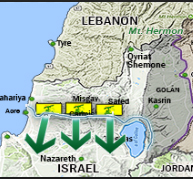
1.  Two sectors are defined for repelling a deep Hizballah thrust into northern Israel; (see map)
(a)  Hizballah is expected to go for the Metulla-Misgav sector on the Lebanese border, as well as the “Fatma Road” linking the Galilee hills north of Kiryat Shemona along the Israeli-Lebanese border.
(b)  Zarit-Shetula in western Galilee north of Nahariya, which is close enough to the Lebanese border for Hizballah troops to reach by land and through tunnels.
Israeli forces will practice driving the enemy out of occupied towns and villages, often using the element of surprise.
2. Another major IDF force will storm across the border into Lebanon for an effort to rapidly and decisively defeat Hizballah on its home ground. The defensive operation apart, the IDF is resolved to inflict on the enemy intolerable losses of life, infrastructure and territory.
This fighting-to-win strategy draws heavily on the negative lessons of the 2006 war, debkafile’s military sources report. Then, the IDF’s overreliance on air might for winning the war proved counterproductive. By the time ground troops were deployed to cross the border and challenge Hizballah, they were too few and too late.
3.  This time, the air force is practicing a different role in the conflict, in coordination with Israel’s heavily upgraded, multi-tier air defenses. They will not only be geared for contending with Hizballah’s vast 100,000 rockets and missiles, but also, for the first time, with a formidable fleet of assorted UAVs, which are designed to serve the enemy in multiple tasks: intelligence-gathering, delivering rockets and guided  drones packed with explosives.
Also for the first time, the IDF will prepare to order the evacuation of civilians, up to 75,000, from towns and village within close range of Hizballah fire. Their evacuation may take place by roads that are under enemy attack.


lördag 20 maj 2017

USA attackerar Hizbollah

1½ artiklar bortglömda av TT.


Hizballah’s elite force sustains heavy casualties from US air strike 

DEBKAfile May 19, 2017, 6:46 PM (IDT)


Most of the damage inflicted by the US air strike Thursday in South Syria was sustained by Hizballah’s elite unit, the Radwan Force, DEBKAfile’s military sources disclose. This was the first aerial attack the United States has conducted on a combined Syrian-Iranian-Hizballah convoy in the seven-year Syrian war. Our sources add that the US jets and assault helicopters took off from the Ayn al-Asad air base in western Iraqi for an operation to prevent the convoy from reaching the strategic Al-Tanf crossing at the intersection of the Syrian, Iraq and Jordanian borders. They hit at least three of Hizballah’s armored vehicles and several trucks, which caught fire. The Americans and Hizballah have both imposed a blackout on the details of the incident and the scale of casualties. 


DEBKAfile ran a number of stories this week disclosing the activities of US, British and Jordanian special operations forces in southern Syria for taking over key segments of the Syrian-Iraqi border, including the Al-Tanf crossing. US Secretary of Defense James Mattis commented this week that Washington had not change its policy of non-intervention in the Syria war, adding, “But we will defend our troops.” 


Syria & allies push back at US-held border post
DEBKAfile Exclusive Report May 20, 2017, 6:50 PM (IDT)
|Norwegian Special Forces arrive at Al-Tanf crossing

|Norwegian Special Forces arrive at Al-Tanf crossing
The Syrian-pro-Iranian-Hizballah force in southern Syria renewed its advance on the Iraqi border on Saturday, May 20, two days after sustaining heavy casualties from a US air strike on its convoys and in spite of US Defense Secretary James’ Mattis warning, “We will defend our troops.”
Syrian military sources reported the capture Saturday of the Suweida region and another 60 square kilometers. This offensive brought the Syrian army and its allies closer to the strategic Al-Tanf crossing at the Syrian border intersection with Iraq and Jordan, which is held by US and other special operations units.

The US-led coalition force is also made up of elite units from Britain, Holland, Germany and the Czech Republic, as well as Jordan and a large contingent of the rebel Free Syria Army trained and armed by American instructors in Jordan.
The latest arrival to boost this force, DEBKAfile’s military sources report, was a unit of Norwegian special forces, which entered Syria from Iraq through the Al-Waleed border crossing in western Anbar. They arrived along with American reinforcements and linked up with the US and British forces deployed at Al Tanf.
However, the Syrian force and its allies to the US air strike moved fast enough Saturday to threaten the FSA troops fighting there with being trapped by a siege. They have pushed their offensive forward against the US-led force, despite their losses from an American air raid, as a show of defiance that was timed for President Donald Trump’s arrival in Saudi Arabia.

Another US air strike appears to be unavoidable for pushing them back. The danger is also rising of a major clash on the ground between US-led coalition special forces troops and the combined Syrian-Iranian-Hizballah force.
The US bombardment of that force Thursday underlined for Saudi Arabia and the dozens of Arab and Muslim rulers, gathered in Riyadh to meet the US president, his administration’s determination to prevent Iran and its Lebanese surrogate, Hizballah, from gaining control of Syria. American troops were accordingly engaged proactively in securing the border crossings between Syria and Iraq.

However, Tehran, Damascus and Hizballah are evidently not about to shirk a direct confrontation with Washington and the Trump administration, apparently with the support of Moscow.

This clash of arms is likely to expand into an outright US showdown with the US and Syria, Iran and Hizballah in the next 24-48 hours ahead of President Trump’s visit to Israel, the second stop of his four-national trip  

   Hizbol


tisdag 28 mars 2017

Hizbollah inte terrorister?

En stor del av Arabvärlden inklusive EU anser inte de är terrorister.


För åratals sedan publicerade Israel en karta över Hizbollah­­anlägg­ningar i södra Libanon, länk1, länk2, alla förbjudna av FN, men vad bryr sej EU-regeringar om sådana detaljer.  Du inser lätt hur mycket bättre IDFs kartor är nu

Läs noggrant nedanstående artikel och förklara sen varför Lövén&Väggström inte an/inser/ att de är terrorister. 
.

World shrugs as Hezbollah prepares massive civilian deaths

Lebanon has made Hezbollah, whose rocket launchers are in homes and villages, part of its official army, making it responsible for civilian deaths on both sides should war erupt. Where is the UN?


Noah Beck, 25/03/17 22:38


Hezbollah leader Hassan Nasrallah recently warned Israel that his Iran-backed terror group could attack targets producing mass Israeli casualties, including a huge ammonia storage tank in Haifa, and a nuclear reactor in Dimona.
Also last month, Tower Magazine reported that, since the beginning of the Syrian civil war, Iran has provided Hezbollah with a vast supply of “game-changing,” state-of-the art weapons, despite Israel’s occasional airstrikes against weapons convoys.
In a future conflict, Hezbollah has the capacity to fire 1,500 rockets into Israel each day, overwhelming Israel’s missile defense systems. Should such a scenario materialize, Israel will be forced to respond with unprecedented firepower to defend its own civilians.
Hezbollah’s advanced weapons and the systems needed to launch them reportedly are embedded across a staggering 10,000 locations in the heart of more than 200 civilian towns and villages. The Israeli military has openly warned about this Hezbollah war crime and the grave threats it poses to both sides, but that alarm generated almost no attention from the global media, the United Nations, or other international institutions.

Läs vidare. Och förundra dej sedan hur Israel kan anfalla en icke-terroristdeklarerad terroristorganisation utan anledning som är uppenbar i svenska massmedia. 


fredag 24 mars 2017

Israels genuint LAGLIGA rätt att skjuta ner vapenlevranser till Hizbollah i Syrien.


Are Israeli raids on Syrian targets legal?

Facing an increasingly dangerous Hezbollah, Jerusalem correctly understands that even a failed state has legal obligations not to assist in terrorist assaults against Israel.

Prof. Louis René Beres, 


fredag 29 januari 2016

Ryssland har släppt fram Hizbollah nära Jordansk-Israeliska gränsen, de två länderna rasande på Putin.

Jordan och Israel har skickat rasande meddelanden att Putin brutit sina löften att hålla Hizbullah från gränsen mellan Syrien och Israel/Jordanien. Situationen är kritisk - Jordanien och Israel kan tvingas slå tillbaka.

onsdag 2 december 2015

Netanyahu erkänner att de är aktiva i Syrien.

Israel har aldrig erkänt att de själva är aktiva mot Hizbollah i Syrien, det har avslöjats av arabiska media och Obama.


Netanyahu acknowledges 'Israel is active in Syria'

PM makes most explicit revelation of Israeli airstrikes yet, saying 'from time to time' state acts to prevent weapon transfers to Hezbollah.

By Ari Yashar
First Publish: 12/1/2015, 4:00 PM

Israeli, Russian officials to meet for talks on continued Syria coordination

Prime Minister Binyamin Netanyahu on Tuesday confirmed for the first time that Israel occasionally conducts military activities in Syria to prevent threats on its borders, in the most explicit acknowledgement yet of Israeli airstrikes that have been long reported by the Arab press.

Israel "is active from time to time in Syria," Netanyahu said at the Eighth Galilee Conference held in Akko (Acre), which was attended by various leading coalition and opposition MKs.

Explaining the action, he said it is intended "to prevent a military front against us, and also in order to prevent the transfer of lethal weapons from Syria to Lebanon."

Regarding action in Syria, Defense Minister Moshe Ya'alon (Likud) confirmed on Sunday that Israel is in full contact with Russia that is conducting its own airstrike campaign, and that Israel resolved a recent breach of Israeli airspace without incident.

Netanyahu's comments on weapon transfers would seem to refer to Israel's long standing policy of working to block advanced missiles from being transferred by Iran to its Lebanese Shi'ite terror proxy Hezbollah.

Arab media has long reported on Israeli Air Force (IAF) strikes in Syria, with a number of the reports cropping up in recent weeks alone, but Israel has remained tight-lipped regarding the reported strikes.

Just last week it was reported by a Saudi news site that the IAF last Monday hit advanced Russian anti-tank missiles capable of piercing the armor of the Merkava Mark IV, Israel's most advanced tank. The missiles were stored just outside of Damascus adjacent to an elite unit of the Syrian army, and apparently were en route to Hezbollah in Lebanon.

Syrian media for its part last week alleged that the IAF struck a Hezbollah base in the mountainous Qalamoun border region between Syria and Lebanon.

Three weeks ago Arab media reported that the IAF struck near Damascus International Airport, in a bombing apparently targeting a weapons transfer to Hezbollah, and earlier in November it was reported that the IAF struck an advanced missile transfer, including long-range Scud missiles, as they made their way through Qalamoun en route to Hezbollah.

Concerns over missile shipments to Hezbollah are well-founded, as shown by an updated Israeli assessment released earlier last month which revealed Hezbollah has no fewer than 150,000 missiles pointing at Israel.


tisdag 23 juni 2015

Irakiska shiitiska terrorister (d.v.s. Hizbollah) delar armebas med USA i Irak.

Att Obongon och Hizbollah gärna småspråkar med varann vet vi. Obama kämpar med och mot alla i en enda röra,


Caroline Glick: The Americans are providing close air support and training Hezbollah. They are even sharing a military base. Hon gav nedanstående länk.

Iran's Forces and U.S. Share a Base in Iraq
The U.S. military and Iranian-backed Shiite militias are getting closer and closer in Iraq, even sharing a base, while Iran uses those militias to expand its influence in Iraq and fight alongside the Bashar al-Assad regime in neighboring Syria.

Two senior administration officials confirmed to us that U.S. soldiers and Shiite militia groups are both using the Taqqadum military base in Anbar, the same Iraqi base where President Obama is sending an additional 450 U.S. military personnel to help train the local forces fighting against the Islamic State. Some of the Iran-backed Shiite militias at the base have killed American soldiers in the past.

Some inside the Obama administration fear that sharing the base puts U.S. soldiers at risk. The U.S. intelligence community has reported back to Washington that representatives of some of the more extreme militias have been spying on U.S. operations at Taqqadum, one senior administration official told us. That could be calamitous if the fragile relationship between the U.S. military and the Shiite militias comes apart and Iran-backed forces decide to again target U.S. troops.

American critics of this growing cooperation between the U.S. military and the Iranian-backed militias call it a betrayal of the U.S. personnel who fought against the militias during the 10-year U.S. occupation of Iraq.

“It’s an insult to the families of the American soldiers that were wounded and killed in battles in which the Shia militias were the enemy,” Senate Armed Services Chairman John McCain told us. “Now, providing arms to them and supporting them, it’s very hard for those families to understand.”

The U.S. is not directly training Shiite units of what are known as the Popular Mobilization Forces, which include tens of thousands of Iraqis who have volunteered to fight against the Islamic State as well as thousands of hardened militants who ultimately answer to militia leaders loyal to Tehran. But the U.S. is flying close air support missions for those forces.

The U.S. gives weapons directly only to the Iraqi government and the Iraqi Security Forces, but the lines between them and the militias are blurry. U.S. weapons often fall into the hands of militias like Iraqi Hezbollah. Sometimes the military cooperation is even more explicit. Commanders of some of the hard-line militias sit in on U.S. military briefings on operations that were meant for the government-controlled Iraqi Security Forces, a senior administration official said.

This collaboration with terrorist groups that have killed Americans was seen as unavoidable as the U.S. marshaled Iraqis against the Islamic State, but could prove counterproductive to U.S. interests in the long term, this official said.

The militias comprise largely Shiite volunteers and are headed by the leader of the Iraqi Hezbollah, Abu Mahdi al-Muhandis. He was sanctioned in 2009 by the Treasury Department for destabilizing Iraq. Al-Muhandis is a close associate of Qassem Suleimani, the Iranian Quds Force commander, who has snapped selfies with the militia leader at key battles.

Other militias that have participated in the fighting against the Islamic State include the League of the Righteous, which in 2007 carried out a brutal roadside execution of five U.S. soldiers near Karbala. The group to this day boasts of its killing of U.S. soldiers. In an interview in February, a spokesman for the militia defended the killings and said his militia had killed many more American soldiers.

Members of these groups have also been deployed by Iran to defend the Assad regime in neighboring Syria. James Clapper, the director of National Intelligence, confirmed in a June 3 letter to seven Republican senators, which we obtained, that "Iran and Hezbollah have also leveraged allied Iraqi Shiia militant and terrorist groups -- which receive training in Iran -- to participate in pro-Assad operations."

The Washington Institute in 2013 identified three militias -- the League of the Righteous, Iraqi Hezbollah and Kataib Sayyid al-Shuhada -- as sending elite fighters to Syria to fight for Assad.  All three help to lead the popular mobilization committees that fight the Islamic State in Iraq.

These militias also stand accused of gross human rights abuses and battlefield atrocities in Sunni areas where they have fought. The State Department heavily criticized Iran’s support for the Iraqi militias and those militias’ behavior in its annual report on worldwide terrorism, released late last week.

“Despite its pledge to support Iraq’s stabilization, Iran increased training and funding to Iraqi Shia militia groups in response to ISIL’s advance into Iraq. Many of these groups, such as Iraqi Hezbollah,have exacerbated sectarian tensions in Iraq and have committed serious human rights abuses against primarily Sunni civilians,” the State Department reported. “Similar to Hezbollah fighters, many of these trained Shia militants have used these skills to fight for the Assad regime in Syria or against ISIL in Iraq.”Accounts of the number of Iraqi Shiite fighters at Taqqadum vary. One senior administration official told us there are “only a few” militia representatives at the base, to coordinate with Iraqi Security Forces, while the bulk of the popular mobilization forces are deployed in the field, mostly around Ramadi, which is held by the Islamic State. A different senior administration official told us that there were hundreds of Shiite militia fighters at the base recently and that they flow in and out of the base for operations in the area.

The U.S. government has sought and received formal assurances from the government of Iraq that the Shiite militias on the base would not interfere with American military personnel. But there’s widespread skepticism that the politicians in Baghdad exert any real control over the hard-line militias. So far, in the 11 months since U.S. special operations forces have been in Iraq, Iranian-supported militias in Iraq and U.S. personnel have not clashed while fighting a common enemy.

“There’s no real command and control from the central government,” one senior administration official said. “Even if these guys don’t attack us … Iran is ushering in a new Hezbollah era in Iraq, and we will have aided and abetted it.”

With the deadline approaching for a nuclear deal that would place up to $150 billion in the hands of Iran, the U.S. is now openly acknowledging in its annual report on international terrorism that Iran is supporting a foreign legion, comprising Afghans, Iraqis and Lebanese fighters, to defend Iranian interests throughout the Middle East.

But the U.S. response to this is inconsistent. In Iraq, America is fighting alongside Iranian-backed militias. In Syria, U.S.-supported forces are fighting against these same militias. The tragedy of this policy is that the Islamic State has been able to hold and expand its territory in Iraq and Syria, while Iran has been able to tighten its grip on Baghdad.

To contact the authors on this story:

Josh Rogin at joshrogin@bloomberg.net
Eli Lake at elake1@bloomberg.net

To contact the editor on this story:
Philip Gray at philipgray@bloomberg.net


söndag 21 juni 2015

Snart bombas mänskliga sköldar i södra Libanon.

Där var ett fasligt gnäll från EU/Sverige när Israel försvarade sig mot Hamas på det enda möjliga sättet, när de avsiktligt placerade mänskliga sköldar på militära mål.

Nu har EU chansen att berätta för Israel hur de ska lösa problemet innan det händer i Hizbollahland. Kan inte EU lösa det problemet är det babbel som kommer från det hållet. Frankrike är nu seglande i Mellanöstern för att lösa alla problem samtidigt som de inte har den minsta aning om hur de ska lösa sina egna islamistproblem.

Varenda installation på kartan strider mot Säkerhetsrådets resolution 1701. Kartan är några år gammal.

Hizbollahinstallationer, för några år sedan.

Amir Eshel explains why Israel has little choice to act if its enemies use civilians as human shields.


Israel Air Force chief Major-General Amir Eshel warned Hezbollah and Hamas in a recent interview with German newspaper Die Zeit that if the situation required, Israel would not hesitate to attack its military command centers situated in civilian buildings in Gaza or Lebanon.

"The strategy of these two organizations [Hezbollah and Hamas] is to wage war on Israel as a way to question our legitimacy," Eshel said, continuing, "so years ago they began to transfer military infrastructure to residential areas thereby turning the population into a human shield."

The Die Zeit interview with Eshel was reported by Channel 2.

"Many villages in Lebanon are built anew to turn into army bases with underground missile sites, and ammunition storage. This is how things are in some areas of Beirut as well," he said.

"What are we supposed to do? Sit quietly?" the IAF chief queried.

Eshel said that the IDF uses various means to warn civilians about attacks including sending text messages in order to give them a chance to take shelter in a safe area.

"We also warn civilians by using small light explosives prior to an attack," Eshel added, emphasizing that the "IDF would not show restraint due to the immoral war tactics of our enemies."

At the beginning of the month, a senior military source said in the event of a new conflict with Hezbollah, the IDF would seek to evacuate more than a million civilians in south Lebanon within 24 hours before proceeding to strike thousands of Hezbollah targets in some 240 villages and built-up regions.

Large-scale Hezbollah rocket and missile fire would be met with civilian evacuations, massive Israeli aerial strikes, followed by a ground offensive, the source said.

Discussing a new strategy for dealing with Hezbollah’s battle doctrine of using civilian built-up areas as military bases to rain death and destruction upon Israel, the source spoke as the IDF approached the conclusion of a week long drill simulating conflict on multiple fronts, including the Israel Air Force practicing striking of large numbers of targets and simulating conflict in northern combat arenas.

“If we have no choice, we have to evacuate 1 million, 1.5 million residents in Lebanon, and act,” the source said. “Hezbollah should not plan to fire on us and try to kill our civilians, and expect that we would respond by acting according to standards it seems to think only exist here.”

Failure to evacuate the civilian population would result in many thousands of non-combatant deaths, according to IDF assessments.

Hassan Nasrallah, the secretary-general of Hezbollah, gave a televised address earlier this month vowing to “displace millions of Israelis in the coming war...if it was imposed on Lebanon.”

Yaakov Lappin contributed to this report.


tisdag 16 juni 2015

EU borde stämmas för alla dess uppenbara lagbrott. Inklusive deras bojkott av Israel.

Här en sammanfattning av alla detaljer hur EU för handelskrig med Israel och bryter otaliga förhandlingsresultat och lagar. EU satt med under Osloavtalet men tycks totalt ha glömt vad som beslutades även om de skrev under på att de hade lyssnat. De har släppt fram terroristgruppen Hizbollah i Europa och hittat att de har "krigiska" och "politiska" delar, vilket innebär att alla som samlar in pengar i EU för deras terrorkrig kan samla in pengar obehindrat.

Krävs inga som helst kunskaper hos de som ovalda beslutar om EU? Läs igenom detta så har du definitivt mer kunskaper.  Ashton nämns där som aktoritet pga hennes fil.kand. i sociologi, vilket är vad EU kräver.

Vill du ha det på svenska så be om det. Googles översättning är rätt bra för våra vanligaste språk så lär dej det.


Europe wages war on Israel: How the Jewish state must respond
By Caroline B. Glick


Despite the EU's Goliath status there are realistic options 

JewishWorldReview.com | This week the EU took three steps that together prove Europe's ill-intentions towards the Jewish state.
First, last Friday the EU announced it is imposing economic sanctions on Israel. The sanctions deny EU funds to Israeli entities with an address beyond the 1949 armistice lines. They also deny EU funds to Israeli entities countrywide that carry out activities beyond the 1949 armistice lines.
The areas beyond the 1949 armistice lines delineated by the EU directive include the Gaza Strip, which Israel abandoned eight years ago; the Golan Heights, which has been under Israeli sovereignty since 1981; eastern, northern, and southern Jerusalem, which have been under Israeli sovereignty since 1967; and Judea and Samaria, over which Israel has shared governance with the PLO since 1994 in accordance with signed agreements witnessed by EU representatives.
The EU's second action was the publication Tuesday of EU foreign policy commissioner Catherine Ashton's letter to her fellow commissioners informing them that by the end of the year, the EU will publish binding requirements for specially labeling Israeli goods produced by Jews beyond the 1949armistice lines exported to EU member states.
This act is potentially more damaging for Israel than the ban on transferring EU monies to Israeli entities with "bad" addresses. Labeling Israeli products is a means of signaling Europeans consumers that they should view all Israeli exports as morally inferior to other goods and wage a consumer boycott of Israeli products. Indeed, Lithuanian Foreign Minister Linas Linkevicius described the proposed labeling as an alternative to a broader boycott of all Israeli goods.
The EU's third act was its decision to define Hezbollah's "military wing" as a terrorist organization, but leave all the other Hezbollah-related institutions untouched. While the move has been applauded by Israeli politicians desperate to deny Europe's animosity, Europe's partial designation of 

Hezbollah as a terrorist entity is another act of aggression against Israel.

By pretending that Hezbollah has a legitimate "political wing" — a transparent lie that even Hezbollah has denied — the EU ensures that Hezbollah personnel and Hezbollah institutions can continue to find safe haven in Europe so long as the avoid attacking non-Jewish Europeans. Hezbollah agents can continue raising money, planning attacks, and recruiting terrorists in Europe, as long as Hezbollah labels the activities "political." In other words, all Hezbollah operations directed against Israel and Jews will remain lawful in Europe.
Beyond exposing the EU's fundamental and obsessive hostility towards the Jewish state, these three actions put paid the EU's protestations of allegiance to international law and commitment to bringing about peace between the Palestinians and Israel.
As Ambassador Alan Baker, the former legal advisor to the Foreign Ministry, wrote in an article published by the Jerusalem Center for Public Affairs, the EU's actions against Israeli entities that operate beyond the 1949 armistice lines are unsupported by international law. The EU's claim that Israel's presence beyond the 1949 armistice lines is unlawful is not supported by any treaties or customs. Indeed, it is explicitly refuted by treaties and customs.
Israel's legal rights to sovereignty over Judea, Samaria and Jerusalem are recognized under the law of nations through the 1922 League of Nations Mandate for Palestine, which also called for "close Jewish settlement" of these areas. The Mandate's allocation of sovereign rights over all of these areas to the Jewish people, and its recognition of the Jews as the indigenous people of the areas, has not been abrogated by any subsequent treaty. To the contrary, they were reinforced by Article 80 of the UN Charter.
Moreover, as Baker noted, the EU wrongly claims that Jewish communities beyond the 1949 armistice lines are illegal under Article 49 of the Fourth Geneva Convention from 1949. But authoritative interpretations of Article 49 make clear that Article 49 does not apply to such communities.
The lines the EU points to as Israel's legal border were never borders and never legal. The 1949 armistice lines, which the EU falsely refers to as the 1967 borders, represent nothing more than the lines at which Israeli forces halted the invading armies of Arab states who illegally assaulted the nascent Jewish state at its birth on May 15, 1948. The armistice agreements explicitly stated the armistice lines lack all legal significance in terms of claims of parties to lands beyond the lines.
Finally, as Baker noted, the EU itself repeatedly supported UN resolutions and international agreements that recognize the legality of Israel's continued control and civilian presence in the areas. As a consequence, its own actions contradict its claim that Israel's presence and the presence of Israeli civilian communities beyond the 1949 armistice lines are illegal.

FREE SUBSCRIPTION TO INFLUENTIAL NEWSLETTER

Every weekday JewishWorldReview.com publishes what many in the media and Washington consider "must-reading". In addition to INSPIRING stories, HUNDREDS of columnists and cartoonists regularly appear. Sign up for the daily update. It's free. Just click here.

Beyond its unsubstantiated legal claims against Israel, both in its intention to label Israeli products and in its actions related to Hezbollah, the EU itself is acting in violation of international law. The EU's intention to label Israeli products involves the imposition of trade barriers in contravention of the World Trade Organization's legally binding rules.
By allowing Hezbollah to continue to operate in the EU, the EU is in violation of binding UN Security Council Resolution 1373 from 2001 that prohibits the use of member states' territory for the benefit of terrorist groups.
Justice Minister Tzipi Livni called the EU's imposition of economic sanctions a "resounding wake-up call," adding, "I hope that now all those who thought it is possible to continue with the freeze [in the peace talks with the PLO] will understand that we have to act to open negotiations, because this is the only way to protect Israel's general interests."
This view, which is the official view of the Left, is based on a complete denial of reality.
The EU announced its sanctions on the very same day US Secretary of State John Kerry announced he had convinced the PLO to return to peace talks with Israel. The confluence of these events could not demonstrate more clearly that the EU's diplomatic onslaught against Israel has nothing to do with the conduct of negotiations with the PLO. If the EU's chief interest was bringing Israel and the PLO to the negotiating table, Brussels would be sanctioning the Palestinians who have refused to negotiate with Israel since 2008.
By levying sanctions the EU does not seek to advance the cause of peace. It hopes to coerce Israel into abandoning its legitimate historic claims as the indigenous people of the land of Israel to the lands allocated to the Jewish people under international law by the 1922 League of Nations Mandate for Palestine. It hopes to coerce Israel into surrendering its right to defensible borders and voluntarily transform itself into an indefensible strategic basket case wholly dependent on the goodwill of outside powers for is survival.
The question is what can Israel do about it?
Were Israel to fight fire with fire and levy counter sanctions on European goods it would be entering an economic war that it would lose and therefore has every interest in avoiding. But Israel's inability to respond in kind to European aggression does not mean it is without options.
Europe is using economic sanctions to expand its political power over Israeli decision-makers. So Israel should act to diminish Europe's political power in Israel.
The EU itself told Israel how to go about doing this in Paragraph 15 of the sanctions directive.. It reads, "The requirements [banning the transfer of EU funds to Israeli entities operating beyond the 1949 armistice lines]… do not apply to activities which, although carried out in the territories . . . aim at benefiting protected persons under the terms of international humanitarian law who live in these territories [i.e., the Palestinians] and/or at promoting the Middle East peace process in line with EU policy."
In other words, Israeli NGOs that receive EU assistance are exempt from the financing ban if they commit to undermining Israel's rights in the area. As the EU sees it, NGOs who receive EU money are EU agents, advancing European goals in the domestic Israeli arena, and as such should be exempted from the EU's economic sanctions.
In a 2010 meeting with US diplomats leaked by Wikileaks, Jessica Montell, the Executive Director of the Israeli registered pro-Palestinian pressure group B'Tselem effectively admitted that her organization would cease to exist without European funding. According to the protocol of the meeting, Montell, "estimated her 9 million NIS ($2.4 million) budget is 95 percent funded from abroad, mostly from European countries."
To stem the momentum of Europe's new economic war, Israel's first response to the EU's sanctions must swift passage in the Knesset of a law requiring all Israeli entities who agree to operate under the EU's funding guidelines to register as foreign agents and report all EU contributions. Those contributions should be taxed at the highest corporate tax rate.
EU officials have stated repeatedly that they seek to undermine Israeli control over Area C. Area C is the area of Judea and Samaria, where in accordance with agreements signed between the PLO and Israel, Israel exercises most civil and military authorities. The EU is funding projects in Area C whose stated goal is to make it impossible over time for Israel to assert its authority over the area.
Israel's second response to the EU's announcement of economic sanctions on Israeli economic activity in Judea and Samaria should be to suspend all EU projects in Area C. Future EU projects should be subject to intense scrutiny by the Civil Administration. Israel's default position should be to reject, rather than approve such requests, given their hostile intent.
Finally, EU peacekeeping forces from Gaza to Lebanon to Syria have repeatedly proven not only their cowardice, but their willingness to act in ways that endanger Israel in order to protect themselves. In Gaza, EU border guards fled to Israel following Hamas's takeover of the area in 2007.
Along the border with Syria Austrian peacekeepers fled at the first sign of trouble leaving Israel to deal with Syrian breaches of the European-sanctioned 1974 disengagement agreement by itself.
European forces in UNIFIL in Lebanon have signed protection agreements with Hezbollah where in exchange for European forces' turning a blind eye to Hezbollah's illegal use of civilian infrastructures as military installations, Hezbollah has promised not to murder European forces.
Given this track record, Israel should bar European forces from further participation in armed forces in Israel. To this end, Israel should allow the mandate of the European-dominated Temporary International Presence in Hebron to expire when it next comes up for review. The TIPH, which has been deployed to the city since 1994, is comprised of forces from Denmark, Italy, Norway, Sweden, Switzerland and Turkey.
Israel has for years been operating under the misguided belief that the EU would eventually come around and side with Israel against its enemies. This belief has been informed by equal doses of innocence and wishful thinking. The EU's decision to initiate an economic war against the Jewish state forces Israel to abandon its long-held illusions. Israel has options for responding forcefully to Europe's aggression. If judiciously and firmly employed, these responses can diminish the Europeans' interest in escalating this economic war, by denying them the political victory they seek.